Journeys of Women

The amazing journeys of historical, fictional, and modern women.

Running away from evil, Running to your calling

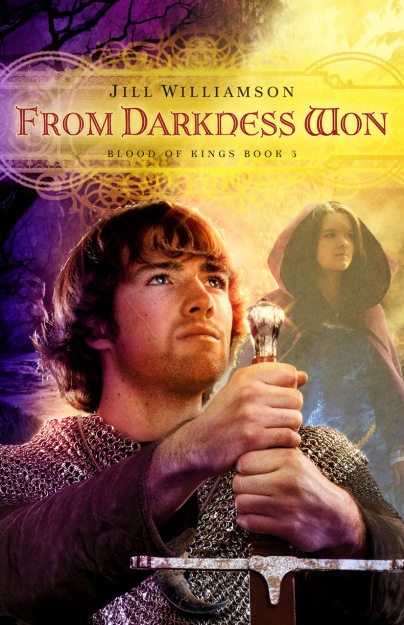
From Darkness Won book cover

I haven’t been able to post on The Compass Rose Queen for a long time. I’m student teaching in middle school math and social studies right now. It’s a blast, but even more stressful than my graduate school classes!

However, I just have to write today. The final installment in my friend Jill’s Blood of Kings trilogy was just released yesterday. I ordered my copy of From Darkness Won from the Marcher Lord Press website this morning. It’ll take all my willpower to keep from reading it until my work sample is done a month from now. I have to find out what happens to Achan and Vrell!

So in honor of the occasion, it’s time to write about Vrell’s journey. Here at The Compass Rose Queen, we honor the heroic journeys of women, both historical and fictional. And Vrell is one of my current favorite literary heroines. The Blood of Kings trilogy is an inspirational medieval fantasy series. For an interactive map of the kingdom Vrell journeys through, see www.jillwilliamson.wordpress.com and click on “Explore Er’Rets.”

In the first book, By Darkness Hid, we discover that Vrell Sparrow is really Lady Averella Amal, daughter of the Duchess of Carmine. Disguising herself as a stray boy, she goes to work for a noble family in Walden’s Watch to avoid marriage to a selfish prince. She assumed the prince would give up and she could marry Bran Rennan, a knight in Carmine. The ruse worked for a while. But then her ability to bloodvoice was discovered by Master Macoun Hadar, and he sends two escorts to bring her to the royal city of Manahaim to apprentice for him.

The journey to Manahaim was miserable for Vrell, who had to survive danger and betrayal while keeping her gender and identity secret. Along the way, she encounters vicious reekats and gentle giants. Her faith in Arman and the loyalty and kindness of one of her escorts keeps her going. Without giving too much away (because you all need to read the books!), near Manahaim she meets Achan Cham and joins him on his mission, along with some knights and other warriors.

In To Darkness Fled, Achan and Vrell and their companions travel north to Ice Island to free more knights loyal to the royal family. This journey proves even more treacherous than her first one. The companions are under frequent attack. Even when they are safe inside cities and fortresses, political intrigue threatens them. Achan and Vrell form an odd friendship, with Achan thinking Vrell is an annoying boy who runs away every time the companions are attacked. Meanwhile, Vrell begins to have feelings for Achan, despite her commitment to Bran.

Achan, so far, lacks the same commitment to Arman as Vrell has. And throughout their journey, she saw him have feelings for more than one woman. So when Vrell has the chance to secure Achan’s love, she runs from it. She discovers that the journey her heart must make is much more difficult than the one she has made in the Kingdom of Er’Rets. But she knows she must stay true to her standards. Even if it means she can’t be true to her heart.

To discover the journeys of Achan and Vrell, be sure to read all three books of the Blood of Kings trilogy. I can’t wait to find out what happens to them in book 3!

Since I wrote at length about a fictional heroine, I’ll keep my historical heroine highlight short. In teaching my students about the Civil War this past month, I discovered a fascinating historical figure that I’d surprisingly never heard of.

Sojourner Truth was born as the slave Isabella Baumfree in New York, 1797. To escape her cruel master, she ran away with her infant daughter shortly before New York emancipated slaves. Living with and working for an abolitionist family, she went to court to regain custody of her son who had been sold illegally. She took on the name of the family she lived with. She also found a new faith at this time. Then she moved to New York City. Later, she renamed herself “Sojourner Truth,” and joined the abolitionist movement. She also got a book about her experiences published, called The Narrative of Sojourner Truth. This book and the public speeches she made helped influence the anti-slavery movement in the North. The second edition of her book had an introduction by Harriet Beecher Stowe, who wrote Uncle Tom’s Cabin. She also spoke for the women’s suffrage movement, with her most famous speech being “Ain’t I a Woman?”

I loved learning about Sojourner Truth as I taught the Civil War. She has the greatest name, for one. And any woman who fights for not only her own rights but also the rights of others commands my respect. Not knowing how to read or write didn’t keep her from getting a book about her life published (she dictated it to a writer). She rubbed elbows with Frederick Douglass and Harriet Beecher Stowe. She’s officially my current favorite historical hero.

Lady Averella Amal (aka Vrell Sparrow) and Sojourner Truth (originally Isabella Baumfree) both ran away from evil. They took on new names and new lives as they served a higher calling. Let us learn from them and live passionately for what we’re called to do as well. Vrell’s story isn’t over yet, and neither is ours.

References

www.sojournertruth.org

www.jillwilliamson.wordpress.com

Categories: Journeys of Women | 1 Comment

November Rains: Time to Curl Up with Pie and a Book

Ah. Autumn in Oregon.

Today is a perfect example: I’m sitting indoors, cozy with a cup of homemade spearmint and lemon verbena tea (thanks to my day job in a school, including horticulture class), as the rains pound the outdoors. As of yesterday, I’m caught up with my graduate studies. And so it’s time to write a little. And what better to write about than a couple of perfectly cozy books and one of my all-time favorite true heroines?

Here at Compass Rose Queen, we celebrate the journeys of women, both fictional and historical. So today I bring to you a review of two books in a sweet inspirational romance series, each with a strong-willed young woman, and a quick account of one of the most revered heroines of World War II.

In Hillary Manton Lodge’s “Plain & Simple” series, we travel into the world of a fictional Amish community in contemporary Oregon. I have the pleasure of knowing Hillary from a church camp we both worked at, and now I have the pleasure of reading her fun books!

The first book, Plain Jayne, offers a glimpse of a modern Amish community through the eyes of a city girl. Jayne Tate is a motorcycle-riding Portland newspaper reporter. After the death of her father, her boss orders her to take some time off. But Jayne is determined to find a killer feature story, so she relocates to an Amish community to do research, hoping for some peace as well. Meeting Levi Burkholder wasn’t part of her plans, however…

This book was so much fun to read. I swore off romance novels years ago as cheesy escapism. This one, however, is anything but cheesy. Jayne’s witticisms and the sweet Amish family she stays with sucked me in like a tart but sweet piece of pie. (And trust me, there’s plenty of pie in the story itself, too). And I love a good story of culture clashes. I think that’s one of the quintessential journeys of the human race: feeling like an outsider and trying to see if we belong.

At the end of the story, Levi’s sister Sara embarks on the exact opposite journey as Jayne: she hides in Jayne’s trunk, leaving Amish country for the big city of Portland. The second book in the series, Simply Sara, follows Sara’s pursuit of a career and a life in the “English” world. Through Sara’s eyes we see our own culture from an outsider’s point of view. A village girl with big city dreams, Sara’s journey to find where she belongs mirrors Jayne’s, but in a different way. I won’t tell you where Sara and Jayne end their stories, but both have sweet family reconciliations, a deeper understanding of faith, and of course, romance.

So curl up with both of these books and a piece of pie and a cup of green tea (Jayne’s favorite). And read to the rhythm of the rain on the roof.

For my history highlight, I’d like to remind the world of one of the bravest women of all time. During the Holocaust, Corrie ten Boom and her family hid many Jews from the clutches of the Nazis in her native Holland. Because of this, her family was arrested and sent to concentration camps. She and her sister, Betsie, managed to stay together for a while, bringing each other what joy could be had in such a horrendous place. But they found a hidden joy: bringing light to a dark prison.

Corrie and Betsie encouraged the other prisoners. However, they also prayed for their enemies, the various people who ran the concentration camp. There are so many quotes and stories about these amazing women and what they did with what they were given. The one about her forgiving one of her prison guards years later always moves me to tears. But I encourage you to read Corrie’s own book, The Hiding Place, to hear her story in her own words.

Corrie traveled against her will from her home in Haarlem, Holland, to the women’s extermination camp of Ravensbruck, Germany. But through it all, Corrie and her sister encouraged each other’s faith and even found joy in the midst of suffering. After the war, Corrie traveled to countries around the world to spread her message of hope and forgiveness. She died on her ninety-first birthday in 1983 in California.

As we approach Veteran’s Day, let us remember those who risked their lives during times of war for the sake of others, whether as military personnel or as civilians. And we should celebrate the ones still with us by sharing time together, and of course, some pie…

References:

Plain Jayne by Hillary Manton Lodge. Harvest House Publishers, Eugene, Oregon. 2010.

Simply Sara by Hillary Manton Lodge. Harvest House Publishers, Eugene, Oregon. 2010.

The Hiding Place by Corrie ten Boom, with Elizabeth and John Sherrill. Chosen Books 1971, Bantam edition 1974.

Categories: Journeys of Women | 1 Comment

The Journey Takes an Alternate Trail

Here at Compass Rose Queen, I set out to tell the stories of women, both historical and fictional, who have embarked on an incredible journey of some sort. But then I started graduate school…

There are some amazing female historical figures that I would love to write about. However, many of them already have amazing websites and articles written about them, and I would be adding nothing to them. The time it takes to research their lives to do them justice is also more than I have right now with grad school. So I think it is time to take this blog into slightly different direction.

Instead of alternating between historical figures and literary heroines, I will focus on fiction. Specifically, recently written or currently being written stories. I am lucky enough to be friends with several talented published and unpublished authors who have amazing female leads, and most of them take some kind of journey (all heroic in some way in the end!).

Occasionally, I may write about a real life heroine whose journey story is not well known. But for the most part, I will focus on books (thus giving me an excuse to read for fun in between grad school texts!)

Just because I can’t help it, here is a brief bio of an historical figure that I encourage you all to learn more about. I’ll add another one soon, probably added onto a post about a literary heroine.

I’d like to introduce Maria von Trapp. Yes, of “Sound of Music” fame. But I’m not talking about the Disney-fied version. The real woman was incredible. Did you know that later on in life, she served the people in Papua New Guinea? And the movie actually dumbed down the true story. The real Captain von Trapp was actually engaged to a princess, not a baroness! Maria loved her Lord with all her heart, and loved her family. The Trapp family settled in America and blessed it with many amazing things. I was fortunate enough to see her granddaughter, Elizabeth von Trapp, in concert here in Salem, Oregon.  It was so exciting to meet a descendant of such an amazing woman. Elizabeth was a talented woman, as well, especially with the acoustic guitar. So the real Maria von Trapp has touched people around the world, in one way or another. I encourage you all to read Maria’s first book, The Story of the Trapp Family Singers, on which the musical was (very loosely!) based. Then be sure to read her later memoirs, Maria: The True Story of the Beloved Heroine of the Sound of Music. My favorite part is where she recalls her early attempts to learn English. In attempting to translate “The spirit is willing, but the flesh is weak,” she ended up saying “The ghost is willing, but the meat is soft.” Brilliant.

References:

Von Trapp, Maria. Maria: The True Story of the Beloved Heroine of The Sound of Music. 1972. Avon Books: New York, New York.

Von Trapp, Maria. The Story of the Trapp Family Singers. 1949. Philadelphia: Lippincott.

Categories: Journeys of Women | 3 Comments

Gudrun, Princess of the Hegelings

For the third heroic woman’s journey at The Compass Rose Queen, we revisit the world of legends.The Lay of Gudrun, or Gudrun Lied, was a Middle High German epic poem. It was written in the early 13th century by an unnamed Austrian poet.

The poet was inspired by the Old German epic Nibelungenlied. This work also led to a Norse epic about a girl named Gudrun, but that is a different story. See the recently published story of The Legend of Sigurd and Gudrun by J.R.R. Tolkien to read about that Gudrun.The Austrian version of Gudrun is also spelled Kudrun, and many references use this spelling to refer to this legend to distinguish it from the Norse one.

There are many modern translations and versions of the original poem. I read the prose version of Gudrun by Alma Johanna Koenig, translated by Anthea Bell. Her version was published in 1928 and became a German literature classic. She was deported in 1942 from Vienna to Minsk, a concentration camp. There is no record of her survival. Thus the author of the version of Gudrun I read had her own epic journey, albeit a tragic one. Fortunately for the legend’s sake, Gudrun’s fate was different.

The epic poem named after its central character is a highly romantic story of strength and chivalry. Gudrun was the daughter of King Hettel of the Hegelings. Thirty kingdoms were under his domain, including Denmark, Sturmen, Frisia, and Waleis. Hettel ruled from Matalane, where he held court.

Gudrun, like her mother Hilde before her, was so beautiful that many kings sought her hand in marriage. The first was the Prince of the Moors. King Hettel refused his request, not realizing that his daughter had grown into a young woman. The second was Hartmut, son of King Ludwig of Normandy.

The third was Lord Herwig, ruler of Zealand (or Sealand). He fell in love with Gudrun when he fought in a tournament in Matalane. She fell in love with him as well. When Herwig was denied, he attacked Matalane. Gudrun intervened, saving his life. King Hettel admired his strength and agreed to the marriage, provided Herwig wait a year. Gudrun gave him the kiss of betrothal.

In that year, the Prince of the Moors attacked Matalane, angry that Gudrun had been promised to another after his rejection. While the Hegelings and Herwig’s army went to fight the Moors, Hartmut’s mother convinced him to go kidnap Gudrun while she was unguarded.

Hartmut stole Gudrun, her best friend Hildburg, and many other young women from Matalane. The ladies were first taken to Wulpensand, where King Ludwig hoped to procrastinate returning to Hartmut’s mother, Lady Gerlind. There the Hegelings caught up with and attacked the Normans. Ludwig’s men prevailed, killing King Hettel, and Gudrun and her friends sailed all the way to Normandy.

In Normandy, Gudrun continued to refuse Hartmut’s attempts to wed her. Lady Gerlind hated her for this. Her son’s happiness was worth more to her than doing the right thing. Hartmut left for a voyage, depressed. So Lady Gerlind forced Gudrun to become a slave. She hoped to break her will and convince her to marry Hartmut. But Gudrun remained true to Herwig. Humbly, the princess performed backbreaking tasks. Only Ortrun, Hartmut’s young sister, showed Gudrun kindness. Her friend Hildburg also stayed by her side, demanding that she be allowed to share her work.

Thirteen long years passed until the Hegelings, led by Gudrun’s younger brother Ortwin, and Herwig’s army had built up enough men and arms to attack Normandy. Herwig saw Gudrun and Hildburg washing clothes on the seashore. He did not recognize them, however, and offered them gold for information about the long-lost Hegeling princess. Gudrun tested his love under her disguise. At last she reveals herself, and the couple are happily reunited with a kiss.

Ortwin, however, reminded Herwig of all the other ladies that were abducted as well. They sent Gudrun and Hildburg back to the castle, where Gudrun refused to serve Lady Gerlind anymore. The Hegelings and Zealanders attack and win. Gerlind pleaded for her life, and Gudrun granted it. But her father’s giant friend Wate beheaded her for all the pain she had caused Gudrun. Hartmut, however, is pardoned for his part in the plot. Ortrun is honored for her help.

At last, Gudrun returned to her mother and her homeland. Peace is restored to the land of the Hegelings, and all the ladies restored to their families. Gudrun and Herwig finally marry, after thirteen long years apart.

Gudrun’s journey revealed not only her heart, but the strength of it. This princess had humility, endurance, and strength of will. She had the deepest love for her fiancee, family, and friends. All of these things are what make legends legendary. Gudrun’s legend lives on.

References: Gudrun by Alma Johanna Koenig, translated by Anthea Bell. English translation 1979 by Kestrel books.

http://www.timelessmyths.com/norse/kudrun

http://www.en.wikipedia.org/wiki/kudrun

Categories: Journeys of Women | 4 Comments

A Short but Epic Journey: Rosa Parks

The Compass Rose Queen highlights the heroic journeys of women, whether fictional or historical.  Since my first post is about Eowyn from the Lord of the Rings, it is time to write about a real woman. In my graduate class last month, we watched a film about Rosa Parks.  It impacted me greatly.  I will not attempt a biography here.  This is just a review of the bus ride that changed a country.

Rosa Parks’ journey lasted less than a day, perhaps less than an hour.  But its effects have lasted more than half a century.

Rosa and her husband Raymond were activists in the case to free the “Scottsboro Boys.”    They then worked together for the NAACP where they lived in Alabama, Rosa leading a youth group in it.  In the summer of 1955, she attended an integrated (as opposed to segregated) workshop in Tennessee.  That year Rosa Parks also met Martin Luther King Jr., who was unknown at that time.  She became very determined to stand up for her rights as a human being.

That December, Mrs. Parks got on the bus and sat in the first row for “colored” people, which was right behind the last “white” row.  All was well until the bus became crowded, and the driver demanded she stand so a white man could sit in her seat.  She refused and was arrested.

This was the case that the budding civil rights movement had been waiting for.   Rosa Parks was a quiet, well-respected woman with a clean record.  At a local church, the movement gathered momentum with Martin Luther King Jr. taking leadership.  A city-wide boycott ensued.  Black people in Montgomery, Alabama, refused to ride the buses for 381 days.  That is more than a year of long journeys on foot to work every day, in all kinds of weather.  The community came together to give people rides, while others proudly marched through rain in defiance.

On November 13, 1956, the United States Supreme Court declared segregation on Montgomery buses unconstitutional.  Victory at last!   This paved the way for desegregation in many other battlefronts in the civil rights movement.

One short journey, on which a brave woman stood up (well, technically sat down) for her rights, changed America in a way it will never forget.  I hope her story inspires us all to stand up for what is right.

References taken from rosaparks.org

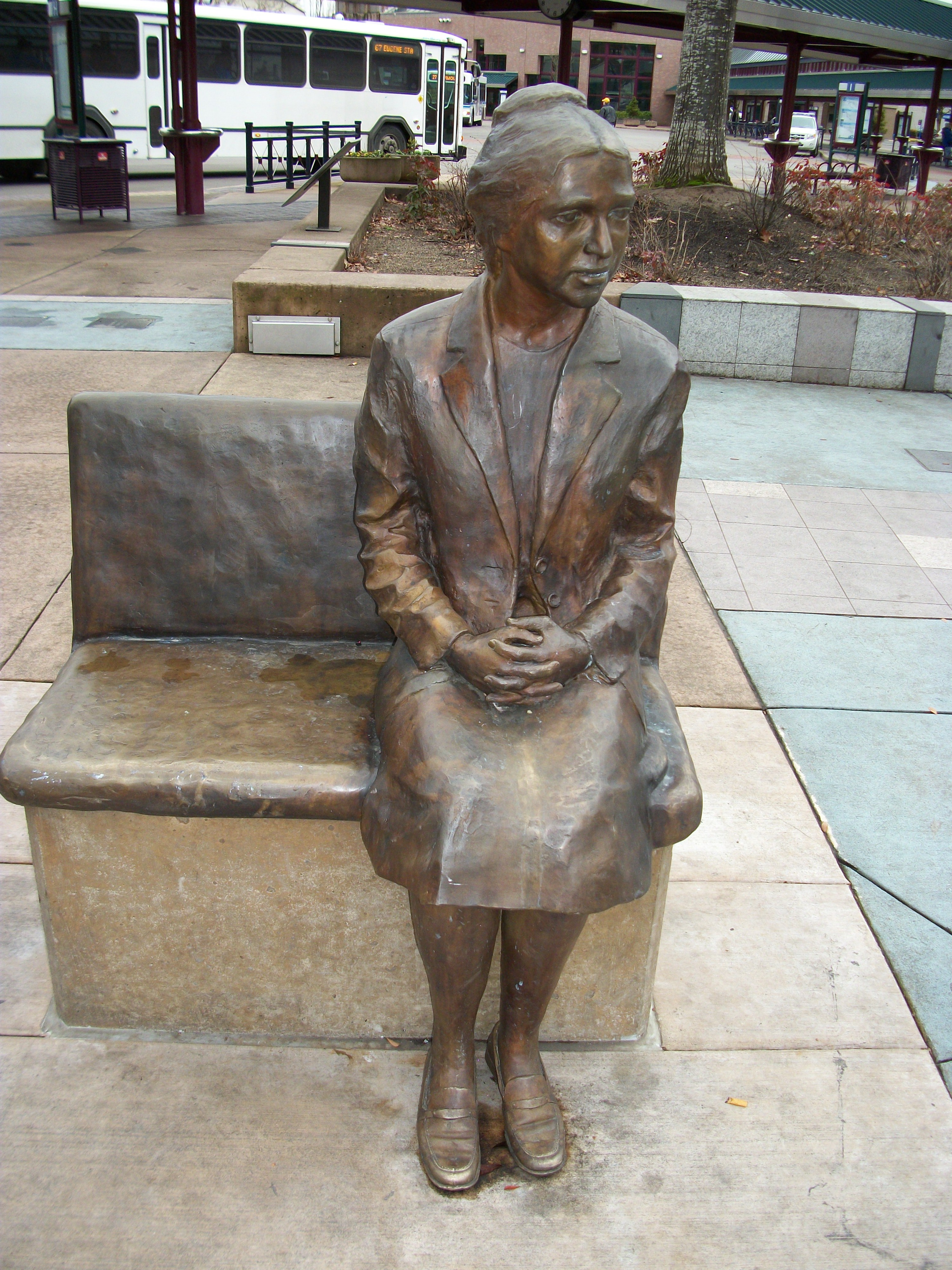
Photo (of a statue of Rosa Parks at the bus station in Eugene, Oregon) by Jessica Johnson

Rosa Parks Statue

Categories: Journeys of Women | 1 Comment

Shield Maiden of Rohan: Lady Eowyn

In my introduction, “The Journey Begins,”  I declared I’d be highlighting a woman of adventure (fictional or historical) in each post.  I’d like to narrow that theme to focus on women who have taken some form of heroic or epic journey.  They may not have intended to be heroic upon setting out, but somehow made a difference in the world.

I wouldn’t be true to myself if my first entry on this theme wasn’t from my favorite books, “The Lord of the Rings.”  And who better to review than Lady Eowyn, slayer of the witch-king?  It is true that Arwen, daughter of the elf-lord Elrond, was the leading lady of the movie version.  In the books, however, Eowyn is definitely the most accomplished heroine.

Eowyn was raised in the fortress of Edoras by her uncle, King Theoden of Rohan.  She was tall, graceful, and had long, golden hair.  Her brother, Eomer, was a great warrior and leader of the Riddermark.  Rohan was a country torn by war with the orcs (Tolkien’s goblins).  Eowyn knew how to use a sword and was called a shield-maiden of Rohan.

When Gandalf the wizard, Gimli the dwarf, Legolas the elf, and Aragorn, the future king of Gondor, came to Rohan to help defend it from Saruman’s orc armies, Eowyn quickly fell in love with Aragorn.  His heart stayed true to Arwen, though.  This drove Eowyn to despair.

Hoping to sacrifice her life for her country, she disguised herself as a man named Dernhelm and rode with Rohan’s armies to battle in Gondor.  The journey was long, more than a hundred miles.  Eowyn allowed Merry the hobbit to ride with her as well, since no man’s horse could bear the extra burden.  They rode into willow thickets by the river Snowbourn, along the river Entwash, through Firien Wood, and between marshes and hills where they heard rumors of war nearby with orcs (similar to goblins).  They rode alongside the mountains separating the kingdoms of Rohan and Gondor.  They were helped through the Druadan Forest by the Wild Men of the Woods.  At last they reached Gondor, but not without having to fight orcs first.

There, with Merry’s help, she defeated the Lord of the Nazgul, Angmar the Witch-King after he mortally wounded her uncle.  Her defiant response to the Nazgul’s taunt of “Thou fool.  No living man may hinder me!” was “But no living man am I!  You look upon a woman.  Eowyn I am, Eomund’s daughter.  You stand between me and my lord and kin.  Begone, if you be not deathless!  For living or dark undead, I will smite you, if you touch him.”  (Taken from the book, not the movie.)  Before she killed him, she was gravely injured by the ringwraith.  Thus her body matched her heart in brokenness.

Aragorn, whom she had loved, tended to her in the Houses of Healing.  He also healed another.  Faramir, Captain of Gondor, was also nearly mortally wounded.  While Aragorn led the remaining armies of Gondor against the orcs at the Black Gate, Faramir and Eowyn recovered in the gardens of Minas Tirith.  Faramir loved her first, but at last Eowyn discovered her true feelings.  Her heart and body were both finally healed.

After the War of the Ring, Faramir and Eowyn married and became the Lord and Lady of Ithilien.

Eowyn journeyed from the fortress of Edoras in Rohan to the battle in the fields of Gondor.  Her heart journeyed through love, heartbreak, courage, hope, and finally joy.  Her story encourages women everywhere.

Where there is courage, there is hope.

References taken from The Two Towers and The Return of the King.

Categories: Journeys of Women | 3 Comments

Blog at WordPress.com.